
Beginning Before You're Ready Isn't the Same as Starting Recklessly |
A practical way to tell when preparation is protecting the work and when it's only delaying the moment you begin. |

Have you ever wondered whether you're genuinely preparing for something important or simply finding another reason not to begin?
That can be difficult to recognize while you're standing in the middle of it. Sometimes there really is something you need to know, build, or put in place before moving forward. Other times, preparation becomes a way to postpone the uncertainty that comes with finally putting the work in front of people.
I've spent years getting that distinction wrong in both directions.
Over the years, I've started businesses and projects involving affiliate marketing, network marketing, coaching, and content marketing. There were times when I delayed publishing or reaching out because the business didn't seem set up well enough. I wasn't certain how all the pieces were supposed to work together, and it was always easy to find another piece that seemed like it should be in place before I really began.
At other times, I did begin. I'd publish some content, receive little or no response, and eventually reach another question I didn't know how to answer. Paid advertising was a good example. I knew Facebook ads might help me reach more people, but I didn't comprehend them well enough to feel comfortable spending money on them.
Not spending money on something I didn't know how to use intelligently wasn't the mistake. The larger problem was that I didn't have much of a plan for what happened next.
There was no end-to-end content strategy carrying one idea into another and no dependable publishing rhythm keeping the work moving. Eventually I'd sit down to write and have no clear idea what should come next, so I'd choose a topic that seemed relevant, publish something when I got around to it, disappear for a while, then eventually come back and choose another one.
The business had technically started, but there wasn't much structure carrying it forward. Over time, publishing became more sporadic, the gaps grew longer, and eventually I abandoned the project.
Looking back, it would be easy to reduce all of that to a lesson about consistency. Start sooner. Keep showing up. Stop procrastinating. There is truth in each of those ideas, but they don't explain the whole pattern because some of what I was missing really did matter.
That's where advice like "start before you're ready" can become misleading. Taken too far, it can make preparation sound like fear and movement sound courageous simply because something is happening.
But beginning before you're ready isn't the same as starting recklessly.
If you're about to invest meaningful money in something you don't comprehend, there may be preparation that matters. If someone is depending on you to deliver something you aren't capable of delivering yet, enthusiasm doesn't remove that responsibility. If the next action carries legal, financial, technical, or safety consequences, there may be knowledge you genuinely need before proceeding.
Those aren't excuses. They're considerations that can change whether the next action is responsible. |
 |
The harder question is what happens when one legitimate unknown begins holding the entire project hostage.
That's where I repeatedly got stuck. Not knowing enough about advertising could become a reason for marketing to remain sparse. Not having the complete business organized could become a reason to delay publishing. Not knowing how the entire strategy fit together could keep me working on individual pieces without ever developing a rhythm that carried the work forward.
One uncertainty could quietly become permission to wait on everything.
The problem is that some questions can't be answered from the planning table. You can research an audience, but eventually you have to communicate with them. You can plan content, but eventually something has to be published. You can study a platform, but some of what matters only becomes visible after real work begins moving through it.
Experience exposes things planning cannot. The challenge is recognizing which gaps should be addressed before action and which gaps can only be resolved through action.
That distinction has become much clearer to me while building the Ryan Dean content operation.
I've been working with a publishing and marketing software ecosystem for about a year through the local newsletter work I'm already doing. During that time, I've developed a much better comprehension of Facebook advertising and how different publishing tools fit together. That particular unknown no longer has the same power to stop me.
Plenty of unknowns remain, though. The content operation itself is still being built while I'm using it. Real articles expose weaknesses that weren't visible during planning. Publication becomes easier to comprehend when there is actually something ready to publish. A newsletter workflow becomes more concrete when actual articles need to move through it.
If complete certainty were the requirement, there would always be another reason to wait.
What is different this time is that I'm not depending on certainty to keep the work moving. There is an end-to-end direction behind what I'm doing. A theme gives the content somewhere to begin. A publishing rhythm creates a reason to return to the work. One article connects to a larger cycle instead of existing as an isolated project, and that cycle eventually moves toward a newsletter. Publication creates experience, and that experience exposes what needs refinement.
The entire system isn't finished, but it doesn't need to be. It needs to be complete enough for the next responsible action to have somewhere to go.
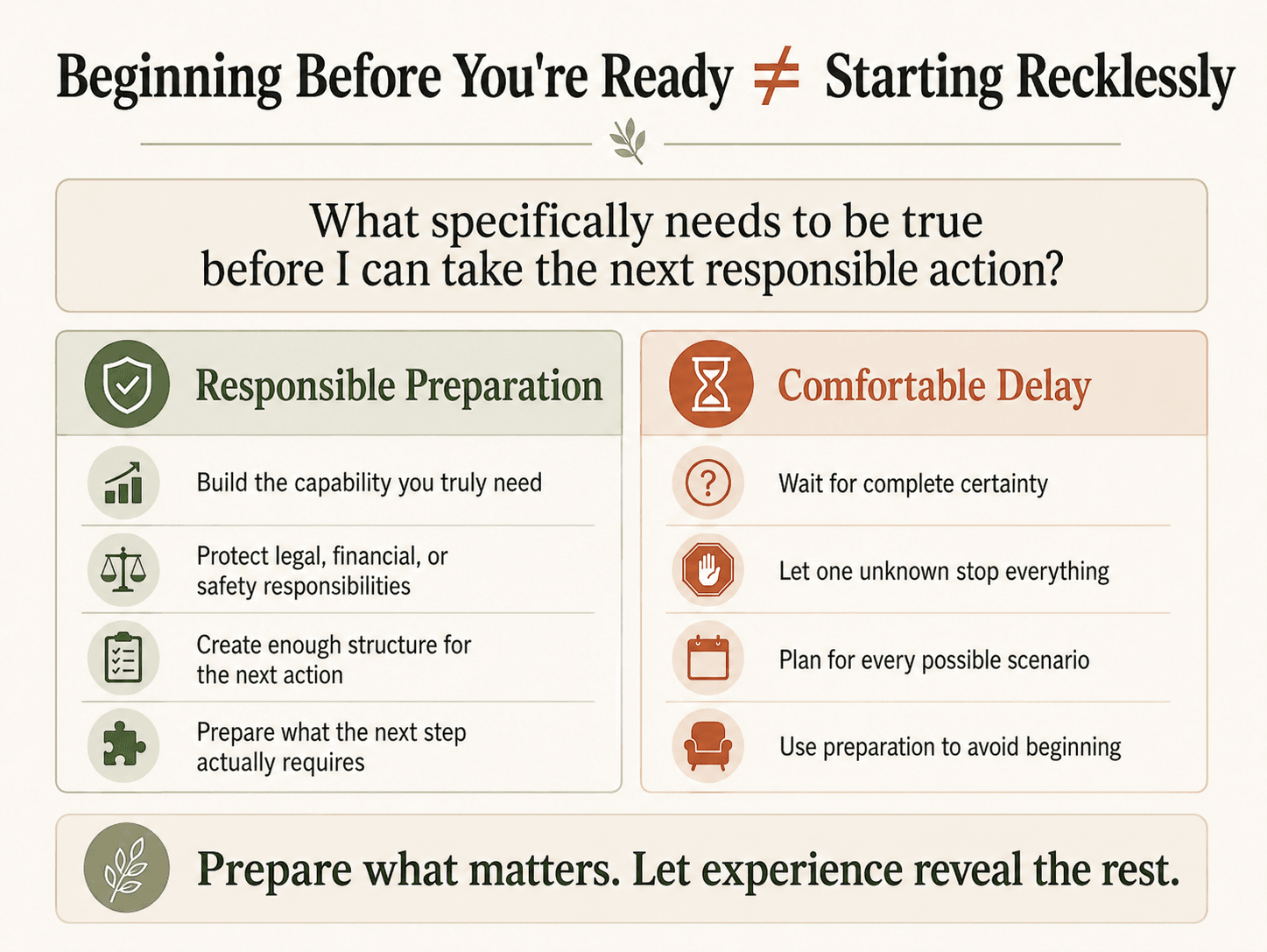
That has become a much more useful standard than readiness. Readiness asks for a condition that may never arrive. Responsible preparation asks a more practical question: Is anything missing that actually prevents the next action from being taken well?
Sometimes the answer will be yes. Maybe a capability needs to be developed before money is committed. Maybe a promise can't yet be fulfilled responsibly. Maybe a basic structure is missing that would cause the work to collapse as soon as the initial enthusiasm wears off.
If so, that deserves attention.
But sometimes the only thing missing is certainty about what will happen after you begin, and no amount of preparation can provide that. Some parts of the path only become visible after you start walking it.
So when "I'm not ready" comes up, it may be worth asking a better question:
What specifically needs to be true before I can take the next responsible action? |
 |
You don't need every future skill today. You don't need every part of the business completed. You don't need answers for problems you haven't encountered yet.
You need enough preparation to take the next action responsibly, then enough courage to allow experience to show you what comes after it.
If something genuinely prevents that action, prepare for it.
If nothing does, the remaining uncertainty may not be a warning at all. It may simply be the part of the journey you haven't experienced yet.
Beginning before you're ready doesn't require ignoring preparation. It requires enough responsibility to recognize what deserves preparation and enough courage to stop asking preparation to guarantee what only experience can show you. |
0 Comments
Join the conversation
Be the first to comment
Share your thoughts above.