
If Readiness Isn't the Benchmark, What Is? |
Beginning exposed what planning couldn't: the difference between responsible preparation and postponing the work that matters. |
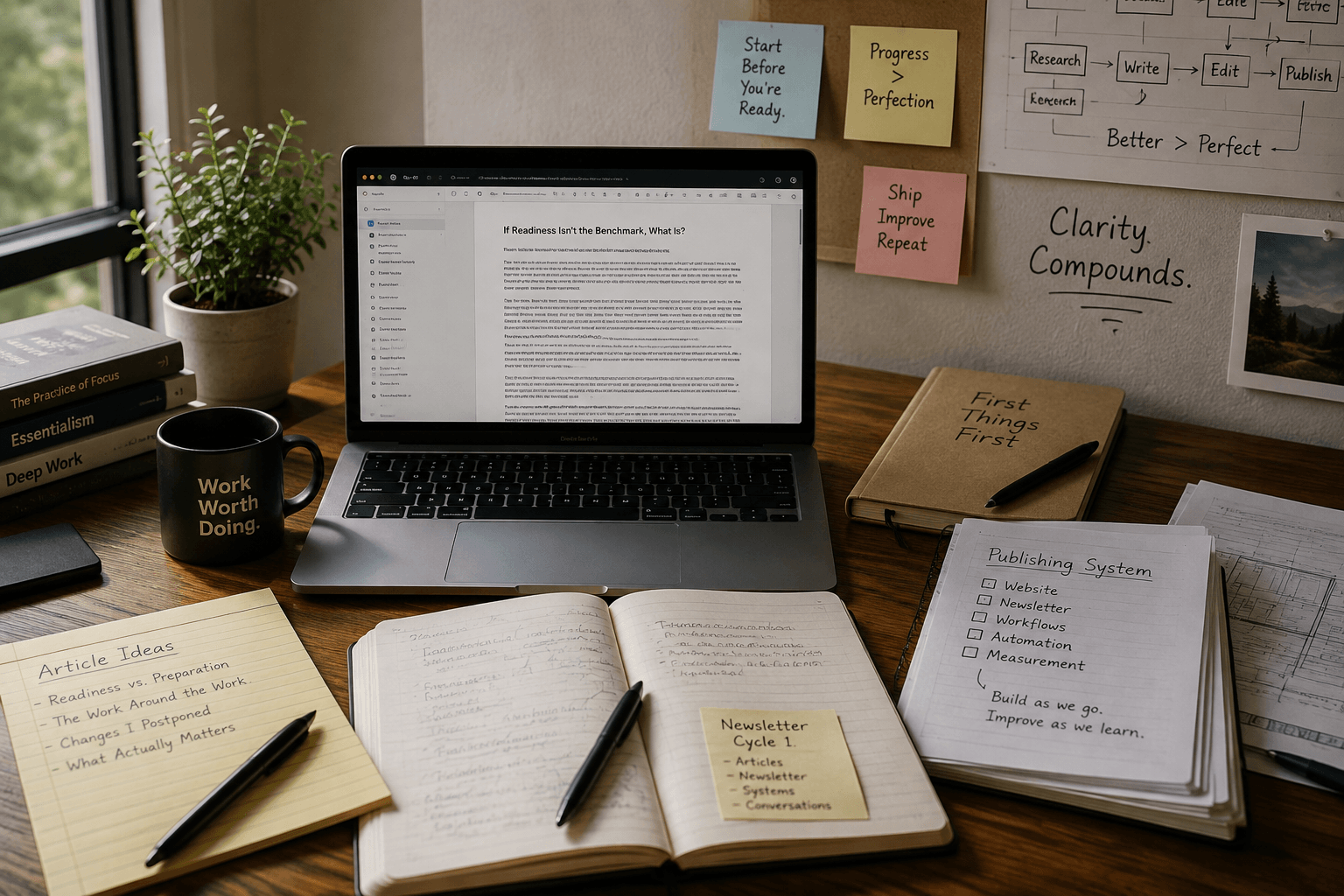
Recently, I decided to begin something I had been preparing for a long time. I am building a publishing rhythm around the ideas, experiences, questions, and discoveries that are shaping my life and work. There will be articles, a newsletter that brings some of them together, and conversations that continue long after I hit publish. Quite a bit of it is still unfinished. The website is being developed. The publishing systems are being connected. The storytelling framework I will use is still evolving. I am discovering how much research belongs behind an article, how far ahead I should prepare, which parts of the process deserve structure, and which parts would become complexity wearing a very convincing disguise. It would have been easy to look at everything still scattered across the workbench and decide I wasn't ready. Instead, I began. Almost immediately, beginning showed me something I had not been able to see through planning alone. My original schedule was wrong. The plan looked reasonable enough when I made it. Develop the theme, conduct the research, create the articles, publish the supporting content, assemble the newsletter and keep moving. On a calendar, it all fit rather neatly. Then the calendar encountered my actual life. I still work a full-time job, and days off have a habit of being considerably less empty than they appear from a distance. Groceries still need to be bought. Errands still need to be run. Life does not seem particularly concerned about my publishing schedule. The writing itself also requires more than sitting down and filling a blank page with words. There are stories worth exploring, claims worth examining, sources worth checking, and ideas that deserve enough time to discover whether they are actually worth saying. Once I was doing the work instead of planning the work, the problem became obvious. I needed more runway. So I changed the schedule. The newsletter will come out later than I originally planned, but the work has not stopped while I prepare for it. I am already developing and publishing the ideas that will eventually lead into that first issue. A previous version of me could have interpreted what happened very differently. See? You're not ready. Get the rest of this figured out first. Finish the systems. Organize everything. Make sure every piece is in place. Then begin. I know that pattern because I have lived it more times than I care to count. I can be extraordinarily productive while avoiding the one thing that actually matters. There is always useful work available nearby. Another piece of research. A tool that could be improved. A folder that suddenly seems desperately in need of organization. A system that could be refined before I use it. None of those things are necessarily pointless, which is exactly why this kind of procrastination can be so convincing. Sometimes the work around the work really does need to be done. Sometimes it is just a comfortable place to hide. That has become one of the harder questions for me to ignore: Is what I am doing helping me engage the thing that matters, or helping me remain safely beside it? Once I saw that pattern, another question became difficult to avoid. What does it actually mean to be ready? If I had waited until everything surrounding this publishing project was finished, when exactly would I have crossed the invisible line from unready to ready? When I was confident that I knew exactly what I was doing? When I had content prepared well in advance? When the storytelling system was finished? When every publishing tool was connected? When the website was complete? There would always have been another condition available. That is what makes readiness such a questionable benchmark. It can sound wonderfully responsible while quietly moving farther away every time we approach it. None of this means preparation is unnecessary. Beginning before you are ready is not the same thing as beginning recklessly. If I were preparing to perform surgery, fly an airplane, wire a house, or make a decision with serious consequences for someone else's life, there would be knowledge, capabilities, permissions, safeguards, and conditions that genuinely needed to exist before I acted. Those are not excuses to delay. They are real conditions that have to be satisfied before the action makes sense. Ignoring them would not be courage. It would be reckless. I have noticed that we get into trouble when we take that truth and apply it to every meaningful beginning, as though nothing should start until the conscious mind can finally say, "Now I'm ready." What happened after I began showed me something different. Beginning did not eliminate preparation. Instead, it made the preparation more useful because I was no longer working only from assumptions. Before I started, I could estimate how much time the work might require, but once I was actually doing it, I had evidence to work from. I could see where the process was heavier than expected, where my work schedule created pressure, and where staying ahead of the publication cycle would allow me to produce better work without turning every newsletter into a small emergency. I did not discover those things by finishing all of my preparation first. I discovered them because beginning gave me something planning alone could not. Reality answered back. That distinction reaches far beyond publishing for me. There are changes in my life that I postponed for years, and in some cases decades. Quitting smoking. Quitting drinking. Changing how I ate. Exercising consistently and reclaiming my health. There was never a shortage of reasons why another time might be better. What is interesting is that I found it much easier to begin without complete preparation inside a work environment. I have accepted responsibilities at work without already possessing every piece of knowledge or experience required to perform them well. That did not seem nearly as impossible because I was not expected to carry the entire journey inside my own head before taking the first step. The knowledge existed around me. There were procedures I could consult and experienced people I could ask. I could begin the work, encounter something I did not know, get an answer, correct what needed correcting, and continue. Nobody handed me all the knowledge I would ever require before I was allowed to move. I did not need to possess everything required for the entire journey. I needed enough to take the next responsible step, along with access to what I would need when the next step appeared. That has caused me to question something I accepted for much of my life. Maybe readiness was never the question I should have been asking. Maybe "Am I ready?" asks the conscious mind to predict a future it has never encountered. Perhaps better questions are available. Why does it matter? What am I actually trying to create? What genuinely must be in place first? What are the real consequences of beginning? What am I preparing because it serves the work? What am I preparing because preparation feels safer than beginning? What am I missing that can be accessed through someone or something around me? And what is the next responsible action I can take with what is available to me now? I do not yet know whether that final question is the complete answer, and I am not interested in pretending that I do simply because it would make for a cleaner ending. That is part of what I intend to explore. What I can already see is that waiting until the conscious mind declared me ready would have kept me from discovering many of the things I needed to know in order to prepare responsibly. So I am doing something different this time. I began before every piece was in place, and when the work exposed a problem, I changed the plan instead of turning the problem into proof that I should stop. Maybe that is one of the differences between preparation and postponement. Preparation helps you continue. Postponement keeps moving the beginning. |
0 Comments
Join the conversation
Be the first to comment
Share your thoughts above.