
A Future Worth Building |
One autumn morning, four friends celebrate a million-dollar milestone and reveal a very different way life could work. |
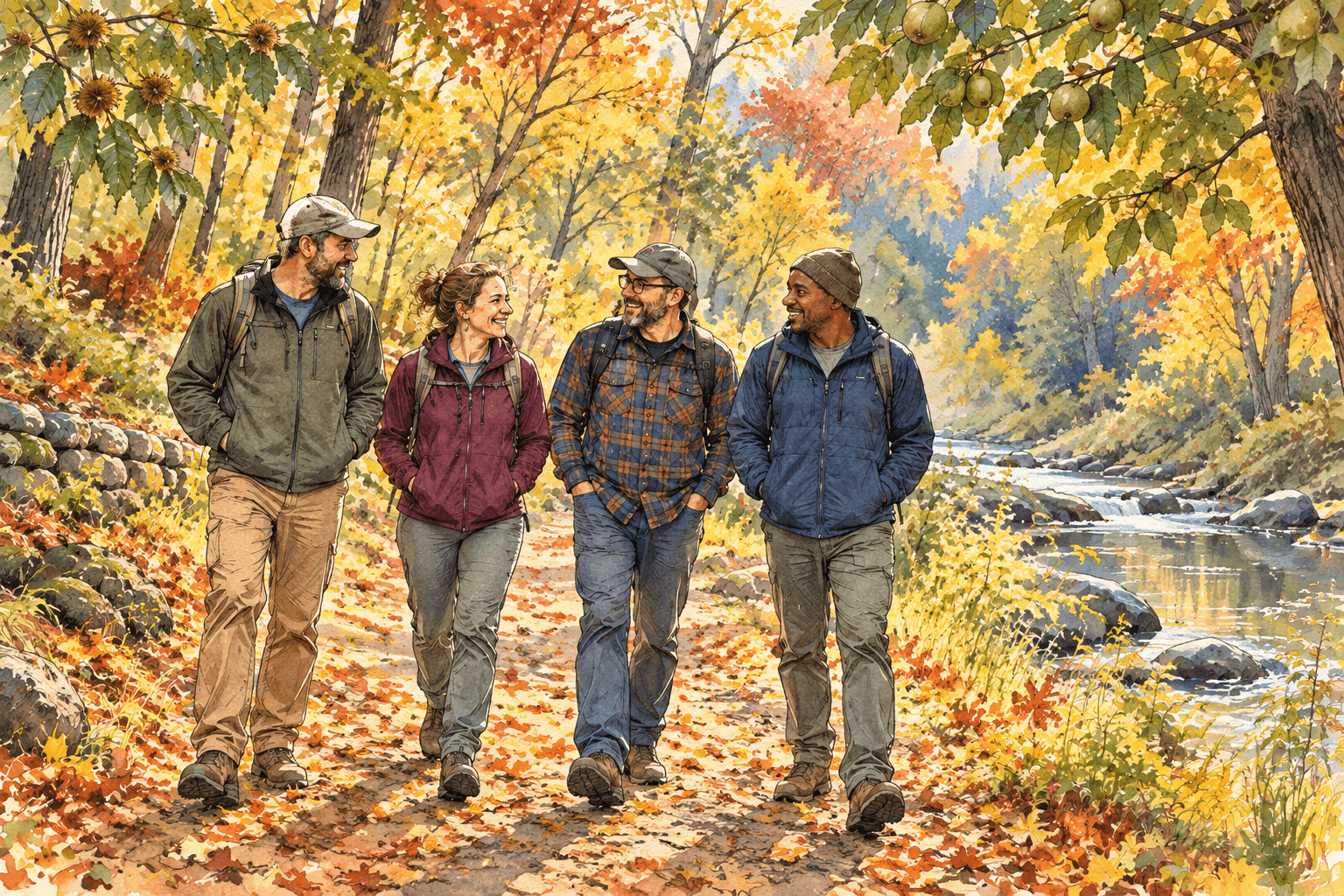
At seven o’clock, the trail was still damp from the night. Leaves had changed high in the canopy, though only a few had fallen. They lay flat against the earth in reds and yellows, bright enough that Daniel kept pointing them out as if the others might have missed autumn without him.
“Best time of year,” he said.
“Agreed,” Mara said.
Eli looked up through the branches. “Easily.”
Tomas walked a few paces before answering. “All right. Yes.”
Daniel laughed. “That sounded painful.”
“I don’t give away agreement cheaply.”
The four of them continued beneath walnut and chestnut trees, past the old pear trees where the trail curved downhill. Most of the harvest had already been carried home. What remained was high in the branches or half-hidden on the ground. Somewhere ahead, water moved over stone. Wind passed through the upper leaves, and a squirrel rustled below them, stopping every few feet to check the places where it had buried nuts.
Mara and Eli walked this trail every morning. Some days they talked the full distance. Some days they returned home having said almost nothing. Today Daniel and Tomas were with them, and the path was wide enough for two at a time.
Tomas had spent the past several minutes watching Mara fail to hide a smile.
“You’re going to have to tell us,” he said.
“Tell you what?”
“Whatever has had you grinning since we left home.”
She laughed. “Is it that obvious? This is why I don’t play poker with you guys.”
Eli smiled but kept walking. Daniel looked from him to Mara. “He knows.”
“Since yesterday,” Eli said.
Mara stepped over a root that crossed the trail. “We reached a million dollars in monthly revenue.”
Daniel stopped. “You did what?”
“Yesterday. For the first time.”
“Wow, that’s amazing!”
Tomas turned fully toward her. “Mara. Congratulations.”
Daniel was already asking whether it had been one large order or several at once. Tomas asked if her team knew. Eli added, with a glance at Mara, that she had checked the final number three times before accepting it.
“Four,” she said.
“Four times.”
They stood in the middle of the trail talking over one another until another gust sent a scatter of leaves down around them. Mara looked from one face to the next, laughing as she tried to answer everything.
“The new orders helped,” she said when they began walking again. “Three communities ordered machines within the same week.”
“The smaller ones?” Daniel asked.
“Yes. The machines that make the hemp blocks. One community is beginning its first homes next spring, so they ordered two.”
Tomas shook his head, smiling. “A million a month.”
They walked on. Their footsteps settled into the quiet again.
After a while, Daniel asked, “How does it feel?”
Mara drew a breath. She closed her eyes and took another. No one moved her toward an answer.
Water ran below the trail. A bird called once from across the creek. The squirrel scratched through another patch of leaves.
Mara opened her eyes.
“Honestly, relieved.”
Daniel’s eyebrows rose. Tomas waited.
“I’m happy,” she said. “I am. It’s deeply rewarding to see what we’ve built reach this point. I can still recall what I expected it to cost.” “Cost?” Tomas asked.
“My life, mostly.” She gave a small laugh. “When I started, I pictured seventy- or eighty-hour weeks in some downtown high-rise. The company gets bigger, the office gets bigger, the bills get bigger, and eventually people call it a successful business.”
Eli glanced at her. “You would have hated the office.”
“Within a week.”
“Two days,” Tomas said.
“Fine. Two days.”
She looked through the trees toward the ridge. Beyond it were their home, her workshop, and the office where she would spend part of the day.
“I thought reaching this number would mean carrying all of that pressure. Instead, I built the company from here. We own our home. There’s no rent, no mortgage, no utility bill showing up every month. Most of what we eat is grown within walking distance. A slow month can still be a hard month, but it isn’t threatening the ground beneath us.”
“And no downtown high-rise,” Daniel said.
“And no downtown high-rise.”
They reached the creek where the trail flattened and the trees opened enough for morning light to reach the water. A narrow wooden bridge crossed to the other side. Someone had left a basket near the entrance for windfall apples, and two sat inside it.
Tomas picked up one of the apples, checked the skin, and put it back. “For the record, downtown does have coffee.”
“So do we,” Mara said.
“Better coffee,” Eli added.
“That has not been established.”
Tomas had lived in the nearby city until five years earlier, when city life had worn him out. Since then, his friends had learned to be careful with any favorable reference to it or he might take it back.
They crossed the bridge without hurrying. Their phones were at home, where they had left them for the walk.
On the other side, Daniel said, “Speaking of downtown, I saw a post last night about that old skyscraper.”
Tomas groaned. “Must we?”
“You don’t even know what I’m going to say.”
“I know the building.”
“They’re decommissioning it.”
That got his attention. “Finally.”
“The plan is to turn the whole site into green space.”
“What kind?” Mara asked.
“They haven’t decided.”
Eli looked back toward the creek. “Knowing politicians, it will probably be a disaster.”
Mara gave him a sideways look. “You could share what you know.” “About what?”
“Growing a food forest. Keeping one alive. All the things you complain about people getting wrong.”
“City officials are not going to listen to me.”
Daniel looked at him. “Who would listen?”
Eli opened his mouth, then stopped. They kept walking.
The trail climbed gradually from the creek. To their left, young hazelnut trees followed the slope in uneven rows. Eli looked across them for a long moment.
“The people living there might,” he said.
“That’s different,” Mara said.
“It is.”
Tomas brushed a leaf from his sleeve. “My aunt did something like that years ago.”
Daniel turned. “In the city?”
“Yes, in the city. Try to contain your surprise.”
“I’m listening.”
“There was an empty lot in her neighborhood. She decided to start a community garden there, so she wrote an opinion piece for the paper. People read it. A few started calling one another. The garden happened.”
“Did she talk to the city first?” Mara asked.
“I can’t recall. The article is what she always talked about. She put the idea before the neighborhood before it disappeared into an office somewhere.”
Eli nodded slowly. “A food forest where the building was.”
“That would be a beautiful use of the space,” Daniel said.
“Paths through it,” Mara said. “Places to sit. The food growing around people instead of being tucked behind a fence.”
Eli was quiet again. This time Tomas watched him.
“You’re writing it now, aren’t you?”
“I’m considering what would grow there.”
“Same thing.”
“It is not the same thing.”
Daniel laughed. “We could write the piece together.”
“We?” Tomas asked.
“All four of us.”
Tomas shook his head. “I left the city because I was finished with city projects.”
“You mention that so rarely,” Mara said.
“I try not to make it my entire personality.”
Eli looked at him. “How generous of you.”
Tomas let them enjoy that. Then he glanced back at the hazelnuts along the slope.
“If you’re serious about fruit trees,” he said, “I can give you the grafting section.”
Daniel smiled. “So you’re in.”
“I said I would give you a section. I did not say I was joining a city project.”
“Of course not.”
“Important distinction.”
The path widened as it rose. Through the thinning trees, they could see the roofs of their homes in the distance and, farther out, the tops of the greenhouses catching the first clean light of the morning. Mara asked how they should open the piece.
Daniel offered a sentence. Tomas rejected it before he reached the end. Eli began describing the site as he recalled it, then stopped to ask Tomas which side of the building caught the afternoon sun. Tomas answered, corrected himself, and answered again.
By the time the trail turned toward home, the four of them were still arguing about the first sentence. |
0 Comments
Join the conversation
Be the first to comment
Share your thoughts above.